We'd prefer it if you saw us at our best.

Pega.com is not optimized for Internet Explorer. For the optimal experience, please use:

Close Deprecation Notice

Use AI responsibly

Mitigate risks and promote trust

What is responsible AI?

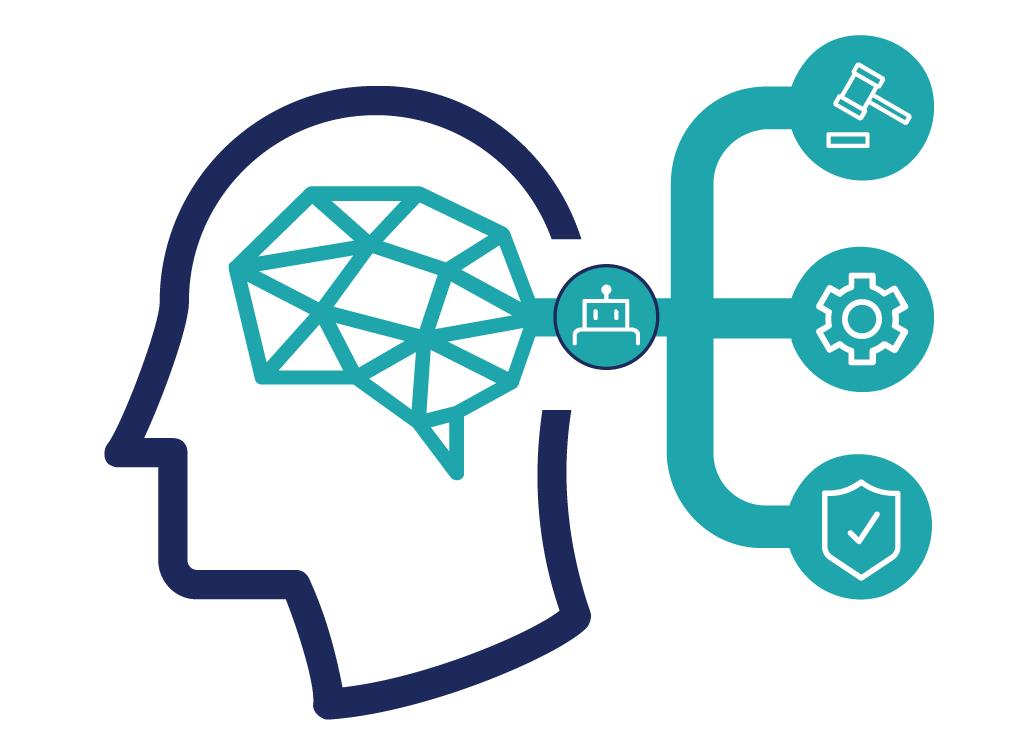
Responsible AI means developing or using artificial intelligence in a way that is ethical, transparent, fair, and accountable – to ensure it’s both safe for society and consistent with human values.

What is Responsible AI?
Why use Responsible AI?

Why is responsible AI important?

Using AI responsibly is critical to ensuring consumer privacy, avoiding discrimination, and preventing harm. Violating consumer trust can damage a brand’s reputation, go against regulatory requirements, and have negative impacts on society.

Benefits of responsible AI

  • Build trust with users and stakeholders
    People – especially consumers – are more likely to adopt and interact positively with AI systems they trust to be fair, transparent, and ethical.

  • Drive inclusive and fair outcomes
    Prioritizing fairness and inclusivity ensures that AI systems serve diverse populations without bias.

  • Stay ahead of regulatory requirements
    As regulatory bodies introduce more regulations governing AI, prioritizing responsible AI ensures compliance with these evolving legal frameworks, helping to avoid fines and legal issues.

  • Manage risk
    Identify and mitigate risks early, including ethical risks, reputational risks, and potential legal liabilities, particularly in areas subject to regulation.

  • Make better AI-powered decisions
    AI systems designed with responsibility in mind often lead to better decision-making. They are more likely to consider a wider range of factors and implications.


  •  

How does responsible AI work?

Responsible AI systems are fair, transparent, empathetic, and robust. For AI to be considered responsible, its decision-making process needs to be explainable, hardened to real-world exposure, and behave in a way that aligns to human norms.

  • The AI Manifesto

    Discover best practices, perspectives, and inspiration to help you build AI into your business.

Download the eBook

What are the core principles of responsible AI?

  • Fairness icon
    Fairness

    Artificial intelligence must be unbiased and
    balanced for all groups.

  • Transparency icon
    Transparency

    AI-powered decisions must be explainable to a
    human audience.

  • Empathy icon
    Empathy

    Empathy means that the AI adheres to social norms
    and isn’t used in way that’s unethical.

  • Robustness icon
    Robustness

    Empathy means that the AI adheres to social norms
    and isn’t used in way that’s unethical.

  • Accountability icon
    Accountability

    Empathy means that the AI adheres to social norms
    and isn’t used in way that’s unethical.

What are some potential AI risks?

Risks associated with opaque AI are amplifying discrimination and bias, driving negative feedback loops that reinforce misinformation based on inaccurate data, eroding consumer trust, and stifling innovation.

How to prepare for and prevent AI risks

  • Oversight and testing
    AI relies on dozens, hundreds, or even thousands of models, so achieving fair outcomes requires testing them frequently and always having human oversight.

  • Data accuracy and cleanliness
    Historical and training data must be high quality, diverse, bias-free, and representative of the actual population.

  • Ethical design
    The intent of the algorithm design and outcomes the organization desires must be ethical and comply with social norms, regulations, and the organization’s values.


  •  
What are some potential AI risks?
Stylized illustration depicting a man with a laptop consulting an AI

Emerging trends: The rise of agentic AI

As AI capabilities continue to advance, we’re entering an era where systems can act with increasing autonomy. Known as agentic AI, these systems go beyond passive predictions—they can pursue goals, make decisions, and take actions on their own, often in dynamic environments. While this unlocks powerful new possibilities, it also raises the stakes for responsible governance.

With agentic AI, the risks aren’t just about biased predictions or opaque models—they extend to how agents interpret goals, how they choose actions, and whether their behavior aligns with human values. Ensuring responsible AI now means proactively designing, monitoring, and constraining these autonomous systems so that their actions remain transparent, accountable, and aligned with intended outcomes.

Responsible AI Isn't a Feature. It's a Foundation

Click any cell to explore the risk, a real-world example, and the Pega capability that addresses it.
For informational purposes only. This tool provides general information about AI-related risks and is not legal or compliance advice. Consult your legal and compliance teams for guidance specific to your organization. Bias & Fairness Explainability Contact Compliance Data Governance Audit & Accountability Financial Services Fair Lending Bias AI models used for credit scoring and loan approvals can inadvertently discriminate against protected classes through proxy variables like zip code or education level, violating fair lending regulations such as ECOA and the Fair Housing Act. A major bank's AI underwriting model was found to charge higher rates to minority applicants, even after controlling for creditworthiness — triggering a DOJ investigation and $80M settlement. Pega's AI Fairness tools detect bias in real time, using T-Tests and transparency dashboards to flag disparate impact before decisions reach customers. Unexplainable Credit Decisions Regulators require lenders to explain adverse actions (ECOA §701). Black-box AI models that cannot articulate why a loan was denied create compliance risk and erode consumer trust. A fintech lender could not provide legally required adverse action notices because its deep-learning model had no interpretable decision path, resulting in CFPB enforcement action. Pega's explainable AI produces human-readable decision rationale for every outcome, mapping each factor's contribution so adverse action notices can be generated automatically. TCPA & FDCPA Violations AI-driven outreach for collections and marketing must respect TCPA consent rules and FDCPA contact restrictions. Automated dialers and messaging systems that ignore opt-outs or contact at prohibited times face significant fines. A financial services firm faced a $10M TCPA class-action settlement after its AI collection system repeatedly called consumers who had revoked consent. Pega's Always-On Compliance layer enforces contact policies, suppression lists, and time-of-day rules across every channel — before any AI-triggered message is sent. Customer Data Consent Gaps Using customer data to train AI models without proper consent or beyond the original purpose of collection violates GLBA, CCPA, and GDPR data governance requirements. A bank used transaction data collected for fraud detection to train a cross-sell propensity model — a purpose not disclosed in privacy notices — leading to regulatory scrutiny. Pega's data governance framework tracks data lineage and consent purpose, ensuring AI models only consume data authorized for their specific use case. Regulatory Model Examination Federal examiners (OCC, Fed, FDIC) increasingly scrutinize AI models under SR 11-7 model risk management guidance. Institutions must demonstrate full lifecycle governance, validation, and ongoing monitoring. During a scheduled OCC examination, a bank could not produce model validation documentation for its AI-based BSA/AML transaction monitoring, resulting in a Matter Requiring Attention (MRA). Pega provides a complete audit trail — model version history, performance metrics, validation reports, and change logs — accessible to regulators on demand. Insurance Discriminatory Pricing Models AI pricing models can embed demographic proxies that lead to unfairly higher premiums for protected groups, violating state unfair discrimination statutes and actuarial standards. An auto insurer's AI pricing model used credit-based factors that disproportionately penalized minority zip codes, prompting a state insurance department market conduct examination. Pega's bias detection continuously monitors pricing model outputs across demographic segments, alerting actuaries to disparate impact before rates reach market. Claims AI Opacity AI-driven claims adjudication that cannot explain denial reasons exposes insurers to bad faith litigation and regulatory action, especially in states requiring plain-language explanations. A health insurer's AI auto-denied thousands of claims without reviewable explanations, leading to a state attorney general investigation and class-action lawsuits. Pega's decision engine provides a transparent rationale for every claims decision, enabling compliant denial letters and supporting internal appeals processes. State-Specific Outreach Rules Insurance marketing and renewal outreach is governed by state-specific regulations that vary widely. AI systems must respect per-state contact windows, required disclosures, and opt-out mechanisms. An insurer's national AI marketing campaign violated several state-specific contact rules simultaneously, resulting in multi-state regulatory action and fines. Pega's jurisdiction-aware contact policy engine applies state-specific rules automatically, ensuring every AI-triggered communication meets local requirements. Health Data in Non-Health Models Using health-related data (wearables, pharmacy records) in non-health insurance AI models raises HIPAA, GINA, and state genetic information privacy concerns. A life insurer incorporated fitness tracker data into its underwriting AI without adequate privacy safeguards, prompting a state privacy investigation. Pega's data classification framework prevents health-sensitive data from flowing into unauthorized AI models, enforcing data-use boundaries at the platform level. State Insurance AI Regulation States are increasingly adopting AI-specific insurance regulations (e.g., Colorado SB 21-169) requiring bias testing, documentation, and regulatory reporting for AI-driven insurance decisions. Colorado's AI governance regulation required insurers to submit bias testing reports by a deadline — those without automated testing infrastructure scrambled to comply manually. Pega's governance dashboard generates regulator-ready bias testing reports and maintains continuous compliance documentation aligned with emerging state requirements. Healthcare Health Disparity Amplification AI models trained on historically biased healthcare data can amplify existing disparities — under-recommending treatments for minority populations or over-triaging based on socioeconomic proxies. A widely-used hospital AI algorithm was found to systematically deprioritize Black patients for care management programs because it used healthcare costs as a proxy for health needs. Pega's fairness monitoring tracks AI recommendations across patient demographics, flagging disparity patterns and enabling clinical teams to intervene before harm occurs. Clinical Decision Support Opacity AI-powered clinical decision support systems that cannot explain their reasoning create liability risks for clinicians and undermine informed consent requirements. A hospital's AI diagnostic tool recommended a treatment pathway but could not explain why, making it impossible for the physician to obtain truly informed consent from the patient. Pega's explainable clinical AI provides factor-level transparency for every recommendation, enabling clinicians to understand, validate, and communicate AI-assisted decisions. HIPAA-Compliant Patient Outreach AI-driven patient engagement and outreach must comply with HIPAA communication rules, including using appropriate channels, respecting patient communication preferences, and protecting PHI in all touchpoints. A health system's AI outreach platform sent appointment reminders containing PHI via unsecured SMS to patients who had not consented to text communication, triggering a HIPAA breach investigation. Pega's HIPAA-aware communication engine respects patient channel preferences and PHI handling rules, ensuring every AI-initiated contact is compliant. Patient Data Consent for AI Using patient data to train or operate AI models requires careful consent management under HIPAA, 21st Century Cures Act, and state health privacy laws — purposes must be disclosed and authorized. A health system used EHR data to train a readmission prediction model without updating patient consent forms to include AI/ML purposes, creating a compliance gap during an OCR audit. Pega tracks patient consent at a granular level, ensuring AI models only access data within the scope of patient authorization and regulatory allowance. ONC & CMS AI Transparency ONC and CMS are implementing AI transparency requirements for healthcare organizations, including documentation of AI model performance, bias testing, and clinical validation. A hospital system could not provide required AI model documentation during a CMS conditions-of-participation survey, jeopardizing its Medicare certification. Pega maintains comprehensive AI model documentation — including clinical validation records, performance benchmarks, and bias audits — ready for regulatory review. Telecom Service Quality Discrimination AI models that allocate network resources, prioritize service, or target retention offers can inadvertently discriminate by geography or demographics, raising FCC equal access concerns. A telecom's AI network investment model systematically deprioritized infrastructure upgrades in lower-income areas, creating a digital divide that attracted FCC scrutiny. Pega's fairness analytics monitor AI-driven service allocation across demographic and geographic segments, ensuring equitable treatment in resource decisions. Churn Model Opacity AI churn prediction models that drive differential retention offers without explainability create customer fairness issues and potential regulatory exposure under consumer protection laws. A telecom's opaque churn model offered premium retention deals to high-ARPU customers while offering nothing to equally loyal lower-spend customers, sparking a consumer advocacy complaint. Pega's transparent next-best-action engine explains why each customer receives a specific offer, enabling fair and auditable retention strategies. TCPA at Scale Telecoms operate massive AI-driven outbound contact operations. TCPA compliance at scale — managing consent, revocations, reassigned numbers, and contact frequency — is a critical risk area. A major carrier's AI marketing platform sent millions of texts without properly tracking consent revocations across channels, resulting in a $50M+ TCPA class-action settlement. Pega's omnichannel consent management tracks consent state in real time across every touchpoint, blocking AI-initiated contacts the moment consent is withdrawn. CPNI Data in AI Models Customer Proprietary Network Information (CPNI) has specific FCC protections. Using CPNI in AI models for purposes beyond what customers approved violates federal telecommunications law. A telecom used call-detail records (CPNI) to train an AI cross-sell model without obtaining required opt-in consent, triggering an FCC enforcement action. Pega's data governance layer classifies CPNI data and enforces usage restrictions, preventing it from flowing into AI models without proper authorization. FCC AI Accountability The FCC is developing AI accountability frameworks for telecommunications, requiring documentation of AI systems used in network management, customer service, and marketing. An FCC inquiry into AI-driven network throttling required a carrier to document its algorithms — the carrier lacked centralized documentation and scrambled to reconstruct it. Pega's centralized AI registry catalogs every model in production, with full documentation, version history, and performance monitoring accessible for regulatory inquiries. Retail & E-Commerce Pricing & Offer Discrimination AI-driven dynamic pricing and personalized offers can inadvertently charge different prices or provide different deals based on demographics, raising consumer protection and discrimination concerns. An e-commerce platform's AI pricing engine was found to consistently show higher prices to users in minority-majority zip codes, prompting an FTC investigation. Pega's fairness guardrails monitor AI pricing and offer decisions across customer segments, flagging demographic disparities before they reach consumers. Recommendation Black Boxes AI recommendation engines that cannot explain why products are suggested create consumer trust issues and regulatory exposure under emerging AI transparency requirements. A retailer's recommendation AI was found to steer certain demographics toward lower-quality products without any explainable business logic, drawing consumer advocacy complaints. Pega's transparent recommendation engine provides clear reasoning for every suggestion, enabling auditable and fair product recommendations. SMS & Email Compliance AI-driven marketing automation must comply with CAN-SPAM, TCPA, and state-specific opt-in rules. Automated systems that send messages without proper consent or ignore opt-outs face significant penalties. A retailer's AI email marketing system failed to honor unsubscribe requests within the required 10-day window, resulting in CAN-SPAM enforcement and a $1.2M fine. Pega's contact policy engine manages opt-in/opt-out state across all channels in real time, ensuring AI marketing respects every customer's preferences. Third-Party Data in AI Retailers increasingly use third-party data (location, browsing, social) to power AI personalization. CCPA, state privacy laws, and FTC guidance impose strict requirements on third-party data use. A retailer's AI personalization engine ingested third-party browsing data without proper consumer disclosure, violating CCPA's right-to-know provisions during a privacy audit. Pega's data provenance tracking identifies third-party data sources in AI models and enforces disclosure and consent requirements at the data-ingestion layer. FTC AI Enforcement The FTC is actively enforcing AI fairness and transparency requirements under Section 5 (unfair or deceptive practices), requiring companies to document and audit AI systems affecting consumers. The FTC ordered a major retailer to destroy AI models and algorithms built on improperly collected consumer data — a precedent-setting "algorithmic disgorgement" action. Pega's AI governance platform maintains comprehensive model lineage, data provenance, and audit trails that demonstrate compliance with FTC requirements. Government Algorithmic Discrimination in Benefits AI systems used in benefits eligibility, fraud detection, and resource allocation can discriminate against vulnerable populations, violating constitutional equal protection and civil rights requirements. A state's AI-driven benefits fraud detection system disproportionately flagged minority applicants for investigation, resulting in a federal civil rights complaint and system suspension. Pega's equity monitoring analyzes AI decision patterns across protected classes, enabling agencies to identify and correct discriminatory outcomes proactively. Due Process & Explainability Government AI decisions affecting individual rights (benefits, licensing, enforcement) must meet due process requirements — citizens have a right to understand and challenge automated decisions. A federal agency's AI denied disability benefits without providing an explainable basis for the decision, leading to a successful due process challenge in court. Pega generates plain-language decision explanations for every AI-assisted government action, supporting due process rights and enabling meaningful appeals. Citizen Outreach Compliance Government AI-driven citizen communications must comply with the Privacy Act, ADA accessibility requirements, language access mandates, and channel-specific regulations. An agency's AI outreach system sent critical notices only in English via a single digital channel, failing to meet language access and ADA requirements for the affected population. Pega's multi-channel, multi-language communication engine ensures AI-driven government outreach meets accessibility, language, and channel requirements. Data Purpose Limitation Government agencies face strict purpose-limitation requirements under the Privacy Act and FISMA. AI models must only use data for the purposes for which it was collected and authorized. An agency repurposed tax data to train an AI fraud detection model for a different program, violating Privacy Act purpose-limitation requirements and triggering an IG investigation. Pega's purpose-bound data governance ensures every AI model only accesses data within its authorized scope, with full audit trails for oversight bodies. Algorithmic Accountability Laws Federal (AI Executive Order 14110) and state algorithmic accountability laws require government agencies to inventory, assess, and publicly report on AI systems used in consequential decisions. Under the federal AI inventory mandate, an agency discovered it had no centralized record of the 47 AI systems operating across its bureaus — scrambling to comply before the reporting deadline. Pega's AI registry provides a centralized inventory of all models with automated impact assessments, supporting compliance with federal and state accountability requirements. The Risk Real-World Example How Pega Addresses It

Frequently Asked Questions about responsible AI

While the terms "ethical AI" and "responsible AI" are related and often used interchangeably, they can have slightly different connotations. In general, both concepts aim to address the ethical considerations surrounding the development and deployment of artificial intelligence, but they focus on different aspects.

While ethical AI primarily concentrates on moral principles and values, responsible AI extends its focus to a broader set of considerations, emphasizing the need for a comprehensive and holistic approach to address the challenges and opportunities associated with AI technologies.

Identifying and reducing AI bias, especially when it's not obvious, requires a combination of careful design, continuous monitoring, and proactive measures. Pega Ethical Bias Check is a great tool that can help you identify fields with bias potential, simulate and test strategies, generate warnings, and validate and resolve biases.

To prepare for introducing AI at your organization, consider the following steps:

  1. Define your goals and objectives: Clearly identify the problems you want to solve or the opportunities you want to leverage with AI.

  2. Assess data readiness: Evaluate the quality, quantity, and accessibility of your data to ensure it is suitable for AI applications.

  3. Build a skilled team: Assemble a team with expertise in AI, including data scientists, engineers, and domain experts.

  4. Develop a strategy: Create a roadmap that outlines the AI initiatives, implementation plan, and resource allocation.

  5. Start small: Begin with pilot projects to test and validate AI solutions before scaling them across the organization.

  6. Ensure ethical considerations: Address ethical concerns related to data privacy, bias, and transparency in AI systems.

  7. Provide training and education: Equip employees with the necessary knowledge and skills to work with AI technologies.

  8. Monitor and evaluate: Continuously monitor the performance and impact of AI solutions and make adjustments as needed.

  9. Foster a culture of innovation: Encourage experimentation, collaboration, and a growth mindset to drive AI adoption.

  10. Stay updated: Keep up with the latest advancements and best practices

Agentic AI refers to systems that operate with a degree of autonomy—setting subgoals or taking actions without step-by-step instruction. Ensuring these systems remain ethical and controllable is a growing focus within responsible AI frameworks.

Ready to learn more?

clv explainer

Tech Knowledge

Learn about customer lifetime value (CLV), an important metric used to determine how valuable a customer is to your enterprise.
Predictive analytics slideshow

Tech Knowledge

Discover how agentic AI can autonomously plan, learn, and adapt—driving agile workflows across diverse applications.
Workflow Orchestration Carousel

Tech Knowledge

Discover how enterprise AI transforms businesses by streamlining operations, enhancing insights, and driving innovation.
AI application Development Carousel

Tech Knowledge

Discover how conversational AI can transform your customer interactions and streamline your business processes.
BPM Carousel

Tech Knowledge

Artificial intelligence seamlessly guides and automates every customer service interaction, from self-service to agent-assisted support.
  • Responsible AI is a winner for everyone

    Find out why Pega Ethical Bias Check earned an Anthem Award from the IADAS for preventing discrimination in AI outcomes.

Read the article
Explore what's possible with Pega
Try now
Ready to build a Blueprint?
Choose the reinvention engine for your needs.
For workflows & app design

Reimagine your processes and turn any workflow into a build-ready application with confidence.

Pega Blueprint™
For marketing & CX strategy design

Visualize customer journeys and engagement strategies across all touchpoints and activate them.

Pega Customer Engagement Blueprint™
Share this page Share via X Share via LinkedIn Copying...