

Three years ago, the argument was that every business needs a map. You built one. Then you hired AI agents and forgot to hand it over.
The original case came from Pega’s Rene Voogt in 2023: dashboards give you facts and KPIs, but a map shows the territory.
Process mining draws that map from your system event logs, the real one, not the documented one. It gave businesses three new abilities: understand processes as they actually run, plot better routes, and check whether those routes are being followed.
Plenty of organizations did exactly that. Then agentic AI arrived, and the discipline quietly fell away.
Your newest workers are traveling blind
An AI agent dropped into your operation is a traveler in unfamiliar territory. No map, no marked hazards, no proven routes. So it improvises. Improvisation at enterprise scale has a price tag: LLM-orchestrated workflows cost five to 20 times more per run than targeted execution. It also has a risk profile: An agent that wanders off the intended path creates compliance exposure, and the wandering triggers no alert.
The strange part is that the map already exists. You mined it. The proven routes of your best teams, the mandatory checkpoints, the dead ends that generate rework: all of it is charted. Your agents just never got a copy.
Hand over the map
Grounding an agent means giving it the mined map before it makes its first decision. Feed discovered process maps, best-path variants, and real KPIs into agent design (at Pega, mined insights flow into Blueprint) and the agent follows the route your business has already proven, including knowing which checkpoints are not optional.
Then watch the trace
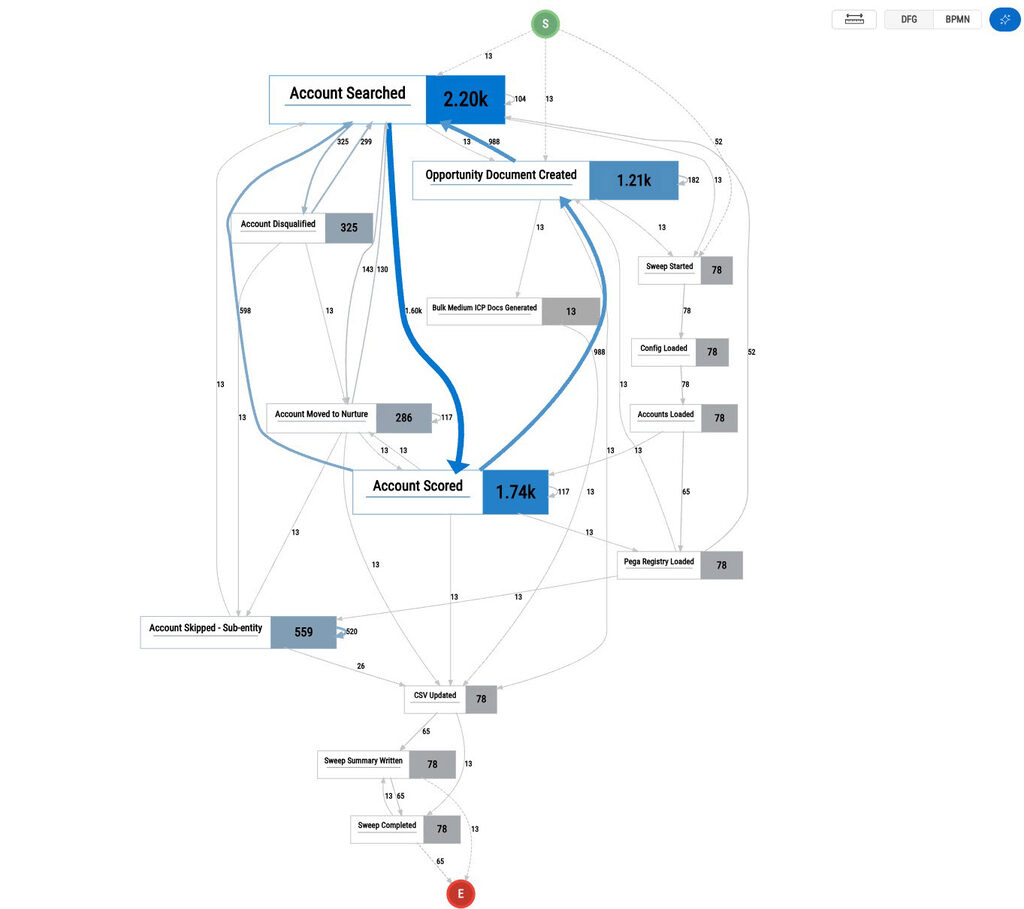
A map gets better when travelers report back. Every agent run writes an execution log: each step, each tool call, each token. Mining those logs is what agent mining means, and it turns your agents from invisible travelers into GPS traces on the same map. You see where they loop, where they drift off route, where they stall at a handoff. One organization traced its agentic business development tool this way and found a single step driving 25% of total processing. Simplifying it cut cost immediately.
The map was never finished
Voogt’s three uses now apply to the agents themselves. Understand what they actually do, not what you designed them to do. Evolve their routes when the trace shows a better one. Monitor whether they stay on course as the territory changes.
The map didn’t become obsolete when agents arrived. It picked up new travelers, and they leave tracks. The organizations reading those tracks are the ones whose agents will actually arrive somewhere.
References
- Rene Voogt, “How process mining tools can take your business where it needs to go,” Pega Blog, April 2023: pega.com/insights/articles/how-process-mining-tools-can-take-your-business
- Pega Agent Mining materials (execution cost comparison and the agentic business development example). Pega Process Mining: pega.com/products/platform/process-mining