
For anyone who has ever interacted with the American healthcare system, “prior authorization” is a phrase that evokes a unique sense of dread. It’s a process notorious for its inefficiency. For many, it feels like a black hole of paperwork, faxes, and phone calls that delays patient care, fatigues medical staff, and drives up administrative costs for everyone. A patient waits anxiously for a critical procedure, a doctor’s office manager is stuck on hold for hours, and an insurance administrator drowns in a sea of disparate documents.
This painful process is a textbook example of a complex, fragmented workflow in dire need for transformation. While the promise of AI in healthcare often feels abstract, statistics show pre-authorization is calling out for a pragmatic, multi-agent AI system that can deliver efficiency gains and improve customer satisfaction while strengthening human oversight and deepening clinical trust.
The crisis by the numbers: Why prior authorization is broken
The inefficiency of prior authorization is not anecdotal. It is a well-documented, systemic crisis with measurable consequences for patients, physicians, and the broader healthcare system.
The data paints a stark picture:

These figures illustrate a system under enormous strain. Te administrative burden of prior authorization isn’t merely a nuisance. It’s also a patient safety issue. When nearly one in three physicians report a direct link between authorization delays and serious patient harm, the cost of inaction becomes impossible to ignore with costly ramifications.
The problem: A cacophony of inefficiency
When we talk to actual clients and patients, what they say confirms flawed business processes, manual pitfalls, and human error. Many of the situations they describe begin with a provider’s office submitting a request, often via fax or a cumbersome portal. This is followed by administrative employees manually reading the request, creating a case, and painstakingly hunting down supporting information.
Team members spend days toggling between disconnected systems, deciphering scanned medical records, and making outbound calls to request missing data. A single case could involve dozens of manual steps performed over several days, with each handoff introducing fresh potential for delay and error. Nurses and highly trained clinical staff are drawn into administrative drudgery instead of applying their medical expertise where it matters most.
The solution: An orchestrated, multi-agent AI system
To address this major process challenge, Aaseya has built a re-engineered pre-authorization workflow leveraging a set of specialized AI agents, all orchestrated on a central platform. (See figure 1)
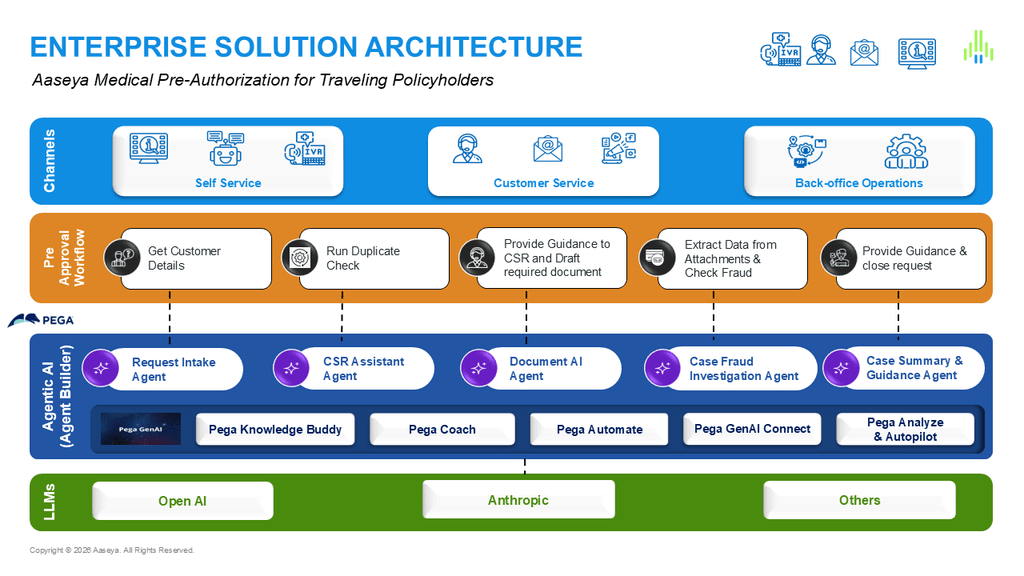
This approach doesn’t seek to replace human experts, but rather builds a powerful support system around them and automates work with agents according to a “6 Rs” framework as follows:
Receive
The reimagined process begins with an AI-powered intake agent. Instead of faxes and forms, a conversational AI captures all necessary details and autonomously triggers a case. More powerfully, the system can instantly scan and interpret incoming documents (such as a patient’s medical history PDF) extracting relevant data and automatically populating the case file. The manual, error-prone data entry that once took hours is now completed accurately in seconds.
Research and route
Once the case is created, a “research” agent springs into action. It instantly connects to multiple back-end systems to validate patient and provider information, verify benefits eligibility, and run fraud-detection algorithms. It then analyzes submitted clinical data against a library of pre-defined policies and medical guidelines.
Critically, if the AI identifies missing information (a historically common source of delays) it doesn’t simply flag the problem. Instead, it compiles a complete checklist of every missing item and queues a single, consolidated request for the human agent to review before sending it to the provider’s office. The frustrating back-and-forth of “we still need X” and “now we also need Y” is eliminated entirely.
Report, respond, and resolve
With a complete and validated case file, the system is ready for a decision. The workflow automatically routes the case to the appropriate clinical reviewer – such as a staff nurse – but instead of presenting a mountain of raw data, the platform delivers a clean, consolidated view with an AI-powered recommendation grounded in the organization’s specific clinical guidelines. The AI suggests a “next best action” (e.g., “Approve,” “Request Peer Review”), while the clinician retains full authority over the final decision.
This is the pinnacle of human-in-the-loop design: The AI handles the exhaustive, repetitive work of data gathering and policy checking, freeing the nurse to apply expert clinical judgment to what matters most. Because every step, every data point, and every rule applied is tracked by the orchestration platform, the entire process is 100% auditable.
The results: Efficiency, speed, and trust
By shifting from a manual process to an AI-orchestrated workflow, organizations have the potential to achieve transformative outcomes across the key metrics that were previously so troublesome:
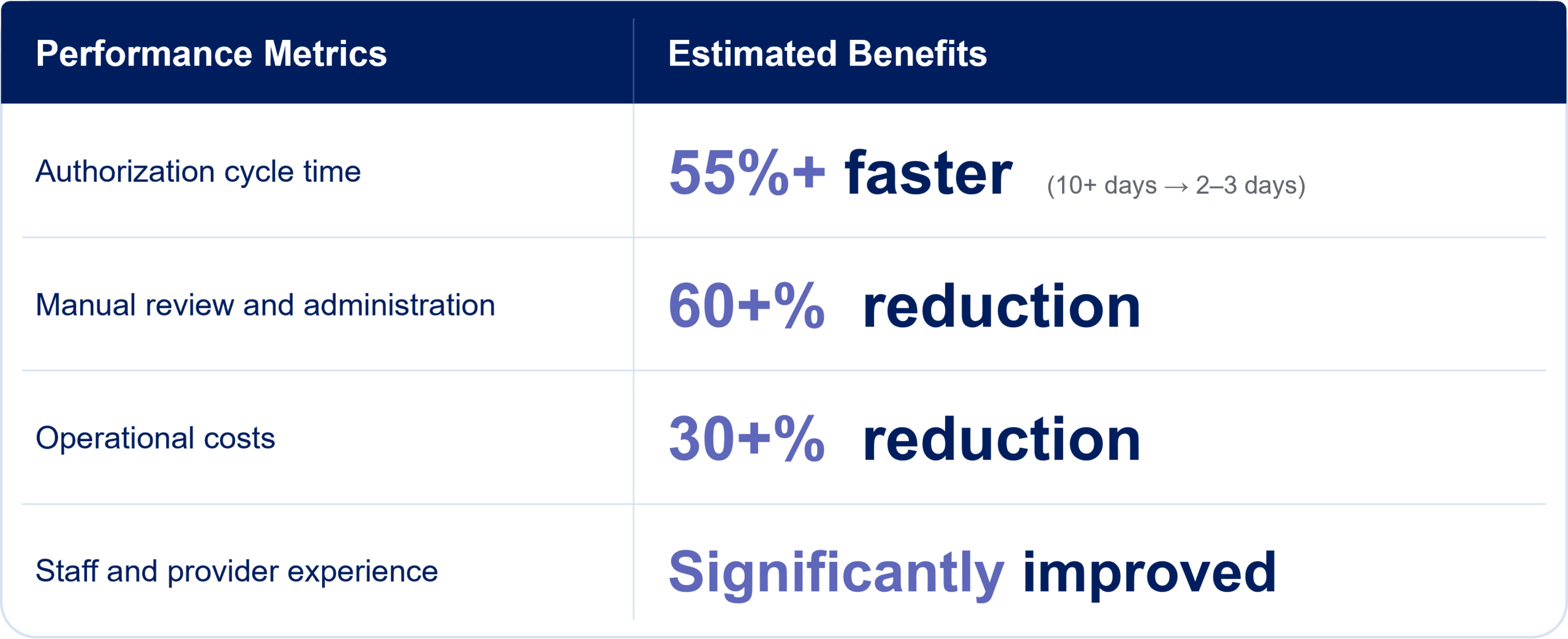
These impressive numbers represent a direct response to the patient safety and operational crisis described in the industry data above. Faster authorizations mean fewer treatment delays. Reduced administrative burden means clinical staff focused on care, not paperwork. And measurable cost savings create room to reinvest in the patient experience.
The broader lesson: Orchestration with governed AI agents inside is the key
Here we have a powerful lesson for any industry bogged down by complex, fragmented processes. The greatest value from AI does not come from a single, monolithic model attempting to do everything at once. It comes from a well-orchestrated team of specialized agents (that focus on work that agents are good at) working in concert with human experts within a governed, auditable framework.
In healthcare, where the stakes could not be higher, this approach demonstrates that AI-driven transformation is not about removing humans from the equation. It’s about empowering them by eliminating the administrative noise so that skilled clinicians can level-up and do what only they can do: exercise expert judgment in service of patient care.
Want to learn more about our agentic architecture and how Aaseya and Pega are working together to build mission critical agentic operations? In a recent webinar, we dig into the 6Rs and provide real world examples of agentic operations at work, including a deep dive demo of agentic medical pre-authorization. Watch the webinar on demand today!
Sources:
- AMA Survey Highlights Growing Burden of Prior Authorization: https://www.ajmc.com/view/ama-survey-highlights-growing-burden-of-prior-authorization-on-physicians-patients
- Prior Authorizations and the Adverse Impact on Continuity of Care: https://www.ajmc.com/view/prior-authorizations-and-the-adverse-impact-on-continuity-of-care
- Prior Authorization Statistics: The Impact of Prior Authorizations: https://triarqhealth.com/blog/prior-authorization-statistics
- Prior Authorization: How It Evolved, Why It Burdens Physicians and Patients, and the Promise of AI: https://www.medicaleconomics.com/view/prior-authorization-history-burden-ai-future
- The Prior Authorization Landscape in 2025: https://www.mgma.com/articles/the-prior-authorization-landscape-in-2025
- Insurers' Prior Authorization Data Offers Little Insight Into What Gets Approved or Denied: https://www.kff.org/quick-take/insurers-prior-authorization-data-offers-little-insight-into-what-gets-approved-or-denied/