

There's a good chance you've been meaning to deal with this for a while.
You know the applications we're talking about: the approval workflows, the case routing tools, the document management systems your teams open every single morning. The ones built on Lotus Notes. The ones that have been running, somehow, for 20 or 30 years. The ones nobody wants to touch because they work (sort of) and changing them feels like open-heart surgery.
If that sounds familiar, you're in very good company.
A groundbreaker that rewrote the rules
Cast your mind back to 1989. The internet as we know it didn't exist. "Collaboration software" wasn't a category. And then Lotus Notes arrived. Genuinely revolutionary.
Before the web had web-like forms, Notes had them. Before cloud servers existed, it had distributed server applications. Before enterprise workflow automation was a standard concept, Notes was routing documents, managing approvals, and connecting teams across continents. IBM recognized the potential, acquiring Lotus in 1995 for $3.5 billion. At its peak, over 130 million users relied on it globally. For a generation of IT teams, Notes wasn't just software. It was infrastructure.
And that's precisely the problem today.
What made it great is now what holds you back
The very things that made Lotus Notes exceptional in 1995 are what make it a liability in 2026.
Its remarkable backward compatibility (applications built in version 1 running untouched through modern releases) meant organizations never had to modernize. So they didn't. 30-year-old workflows still run in production today, doing exactly what they were designed to do, in exactly the same way.
But the world around them has changed completely. Your workforce expects mobile access. Your leadership expects AI-powered insights. Your compliance team expects audit trails that don't require a specialist to decipher. And your Notes developers are retiring, taking decades of undocumented institutional knowledge with them.
IBM sold Notes and Domino to HCL Technologies in 2019, and the IBM-era versions, Domino 9 and 10, officially reached end of support in June 2024. No patches. No security fixes. No help if something breaks.
What was once a competitive advantage is now, quietly, a strategic risk.
The scale of the problem
Here's the thing: This isn't a niche problem. According to Pegasystems research, an estimated 34,000 organizations worldwide still rely on aging Notes and Domino deployments for core processes. And maintaining that technical debt costs the average global enterprise more than $370 million every year in lost productivity, stalled innovation, and delayed transformation.
The most common pattern we see? Organizations migrated email and documents off Notes years ago and declared victory. But the custom, process-centric applications? The hard-coded approval flows? The mission-critical workflows built specifically for your business? Those stayed. Because they're complex, undocumented, and deeply embedded in how your teams actually operate.
The result is what we call the "app jungle": sprawling Notes servers, each running dozens of databases, with no central inventory, no governance, and no clear path forward. Most organizations don't even know exactly what they have until they look. And that's exactly where we start.
A new kind of transformation
For years, modernizing Notes applications meant slow, expensive, manual work: documenting every workflow by hand, rebuilding each application from scratch, and enduring years of disruption before seeing results. No wonder so many projects stalled halfway.
Today, AI changes the equation entirely.
The key insight is this: You don't need to simply recreate your old Notes workflows in a new system. You have the opportunity to reimagine them. Take decades of accumulated process knowledge and rebuild it with modern best practices, agentic automation, and AI at the core. Not a lift-and-shift. A genuine transformation.
That's what Pega's Notes to Blueprint™ is built to do.
How it actually works
The journey runs in three clear stages: analyze your Notes portfolio instantly, reimagine your workflows with AI-synthesized best practices, and migrate to future-proof agentic workflows on the Pega Platform™.
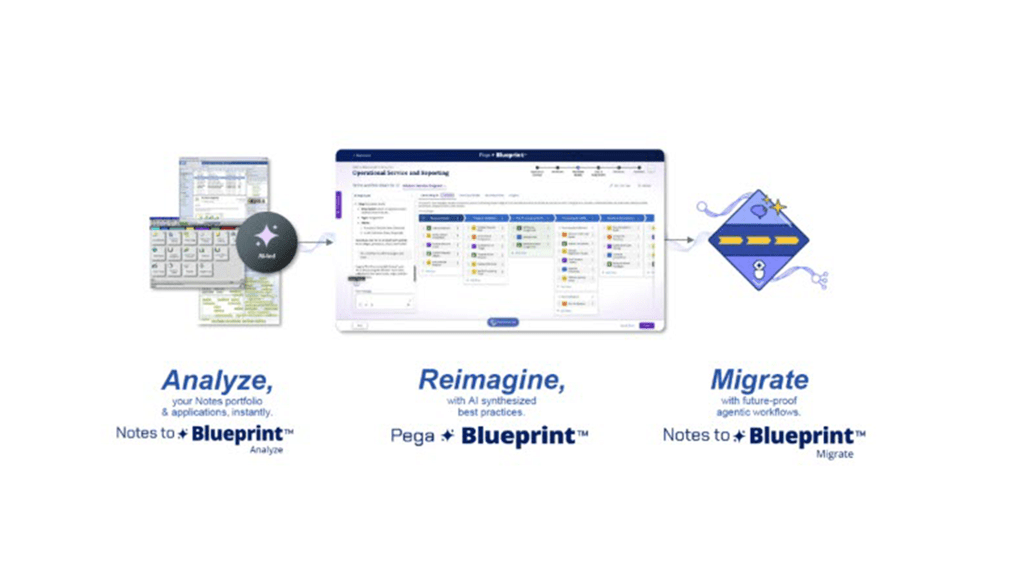
Analyze: Instantly understand what you have
Notes to Blueprint™ Analyze is a lightweight desktop application that connects directly to your Domino servers. It automatically inventories your entire estate: every server, every database, capturing usage data, forms, fields, document counts, active users, agents, last-accessed dates, and more.
In minutes, you have a complete picture: which applications are business-critical, which are actively used, which have automated triggers running behind the scenes, and which can go straight to the archive. No specialist developers. No manual documentation. No guesswork.
A typical Notes estate breaks down roughly as: ~20% core workflow applications ready for transformation, ~30% records management databases, and ~50% legacy data best suited for long-term archival. Knowing this upfront lets you invest transformation effort exactly where it matters most.
Reimagine: Let AI reimagine your workflows
Here's the important distinction: This is not a one-for-one migration. Notes and Pega are fundamentally different languages, built on fundamentally different philosophies.
A classic Notes application might be one long form with different security permissions for different sections as work passes between people. In Pega, that becomes distinct stages, assignments, and steps, each with proper ownership, routing logic, and exception handling built in. The output isn't just a modernized version of what you had. It's a better version of what you meant to have.
The analysis output from Notes to Blueprint™ is packaged as a structured XML file capturing the functional design, workflows, and personas of each application. That file feeds directly into Pega Blueprint® , where AI synthesizes your Notes estate against industry best practices to generate a complete modern workflow design covering case lifecycle, data model, personas, integrations, and all.
Migrate: Go live on a future-proof platform
With your workflows redesigned, the migration path is clear. Core workflows become live agentic applications on the Pega Platform: cloud-native, mobile-ready, and AI-enabled. Data moves into modern records management. Legacy data is archived to a data lake for long-term retention and compliance.
The destination isn't just "not Notes." It's a platform built for continuous improvement, where your processes can evolve as quickly as your business does.
See the value before you commit
Transformation initiatives can feel daunting, especially if you've seen projects promise quick results and deliver years of disruption instead. That's why we've designed an engagement that lets you experience real value firsthand before committing to a full program. Working hands-on with your business and IT teams, we use Pega Blueprint to map your most important Notes use cases, identify the single most impactful workflow to pilot, and deliver a working application built on Pega Platform, based on your actual workflows. Not a mockup. A live app you can put in front of your stakeholders, alongside a clear, costed roadmap for the full transformation.
From first application to full transformation
One of the biggest reasons Notes transformation projects stall is the fear of the unknown. How long will this take? What will it cost? Where do we even start?
The answer is more concrete than most people expect. The journey runs in clear phases, with deliberate Go/No-go checkpoints so your organization stays in control at every step, from a working reimagined workflow as your starting point, to your first core application live in production, to full estate transformation beyond.
The goal throughout is a fast, visible path to value: working software early, expanding from there.
The question worth asking
If you've read this far, you're probably thinking about those Notes applications sitting in your environment right now. The ones powering your approvals. The ones your team opens every morning.
What is keeping them there actually costing you? Not just in maintenance dollars, but in the AI capabilities you can't unlock, the talent you can't attract, and the operational agility you can't build while your core processes are trapped in a platform built for a different era.
The good news is that the path forward has never been faster or clearer. With AI-led transformation, you don't have to choose between speed and quality. You get both.
Your Notes estate doesn't have to be a problem you defer to next year. It can be the transformation story you tell at your next leadership review.
Let's start with a conversation. And a scan.
Ready to see what's inside your Notes estate? Explore Notes to Blueprint™ and take your first step toward transforming legacy workflows into future-proof, AI-powered processes on the Pega Platform.
Sources: Pegasystems/Savanta Research (2025); Enlyft Industry Data; IBM Lotus Notes historical data; Gartner Technical Debt Reports (2023–2025).