
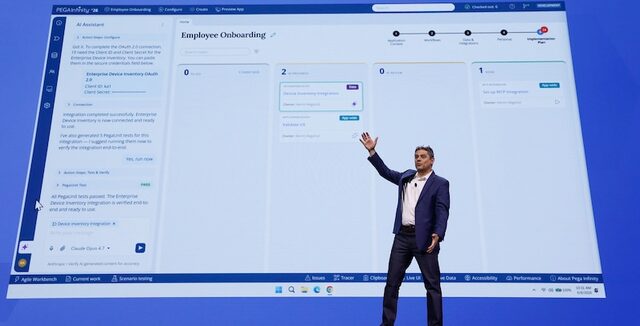
Every enterprise now has access to the same frontier models. Claude, GPT, and Gemini are extraordinary, but they are also commodities. Differentiation was never going to come from which model a company plugs in. It comes from what gets built around that model: the structure that decides when it runs, what it's allowed to touch, and how its output becomes a decision and action your business can stand behind.
That structure – what many are now calling a “harness” – is exactly what Pega Blueprint AI™ provides.
Two ways enterprises are getting AI wrong
Most AI strategies fall into one of two traps.
The first is thinking that AI code is the solution for every problem. More AI-generated code doesn't mean less complexity. It means more code with the logic buried inside it – and harder for a human to read, govern, or change than anything a team wrote by hand. The moat around understanding your own systems hasn't disappeared with AI. It's gotten broader and deeper, because now the models are writing even more code that cannot be fully explained.
The second is letting agents run everything, autonomously, at runtime. That leads to massive unpredictability in outcomes, leaving the enterprise hoping a kill switch or control tower catches whatever goes wrong. This is also where token costs spiral, with orgs paying AI models reason through decisions that have already been made.
Why "kill switch" governance is already too late
A kill switch is a control you reach for after a decision has already been made. A control tower is a dashboard that lets you watch a problem develop in real time. Both assume the same thing: that governance is something you bolt onto AI once it's already running, to catch the moments it gets away from you.
Pega Blueprint AI starts from a different premise. Governance isn't a safety net underneath the workflow – it's part of how the workflow gets designed in the first place. Every decision point, every handoff, every place an AI model gets called is modeled visually, by the people who understand the business and infused with best practices for Pega and our partners, before a single line of anything gets built. If a kill switch is needed later, that's a clear sign the workflow wasn't designed with enough structure to begin with.
The workflow ensures deterministic execution, provides auditability and traceability, and makes it easy to escalate to human when things can’t be processed by either deterministic rules or agent steps. The governance lives embedded in the workflow itself, with the rules and logic clearly visible to stakeholders… and regulators.
What a harness actually does
Blueprint AI harnesses the power of the leading LLMs – currently it uses Claude, GPT, and Gemini for various steps. But it does so at design time to model how work should actually get done. It does so not by generating code, but visually, in a form business and technical teams can both read and agree on. Claude, GPT, and Gemini get called selectively and surgically inside that harness, for the specific reasoning tasks that require them – not as an open-ended agent set loose to improvise the whole process.
Once the workflow is designed, it runs with outcomes and cost that are predictable, because most enterprise work is still deterministic. The steps that need to happen the same way, every time, still do: The AI gets applied exactly where judgment is genuinely needed, not everywhere by default. If an agent is needed, it is applied surgically where it makes sense: to receive new work in unstructured forms, to research additional information, to resolve work by providing summaries and generating documents. But each agent call is tightly bounded to specific tasks, minimizing context drift and preventing runaway reasoning. This is how Pega can offer AI capabilities as a case price, without per token costs.
That's the difference between design-time intelligence and runtime discipline. Reimagine how the work should be structured, using Blueprint AI to harness the power of LLMs and baking governance directly into the workflow itself. Run it with predictable outcomes and predictable cost. And put your critical workflows and decisions on an architecture that stays transparent and changeable as the business, the models, and the market keep moving – because none of those three things are done moving anytime soon.
Why this matters right now
The market is having a tokenomics and governance moment. Usage-based pricing is replacing flat-rate access, and a lot of that cost is invisible – reasoning tokens burn budget inside a model before a client sees a single word of output. That's exactly why a pricing model without per-token fees matters more than a line item. It's the commercial proof of the same idea: Value should be tied to the work getting done, not to how many tokens a model burns figuring it out.
Claude, GPT, and Gemini are only going to keep getting better. That was never really the question. The question enterprises should be asking is what's standing between a powerful model and a decision they're willing to stand behind – a kill switch that you hope reacts after the fact, or a harness that was designed to get it right from the start.