

Picture this: It’s Friday – the best day of the week. You log in, coffee in hand, and open your favorite tool: Pega Customer Decision Hub™. You’ve already seen some wins, but lately, you and your team want to create more meaningful customer interactions. Historically, you’ve focused almost exclusively on sales and cross-sell offers.
Then leadership asks: “Why wouldn’t we just put sales offers in front of our customers? Why aren’t we showing them things that’ll make us money?” It’s a fair question, and one that many organizations wrestle with when they first consider scaling their action library beyond sales. (Spoiler: I have an answer!)
The real issue is something we all experience: banner blindness. When customers see the same offer every time they engage with your brand, they tune it out – especially when they’re not actually looking to buy. The reality is, your customers aren’t always in the market for your products or services, and that’s okay. The key is to recognize those moments and respond accordingly. But show them something different – something relevant to their moment, like travel tips after booking a flight – and you have their attention again.
That’s why scaling your action library isn’t just about adding more actions. It’s about creating enough variety and relevance to break through the noise and actually engage your customers in meaningful ways. The path to better sales outcomes often starts by leading with service, retention, nurture, and resilience messaging.
What is an action? An action is any offer, message, or recommendation you present to a customer – whether it’s a product offer, a service tip, or a helpful reminder. Actions are the building blocks of personalized engagement, helping you deliver the right message to the right person at the right time.
The customer-first mindset that actually works
When organizations set out to scale their action libraries, the instinct is to focus on sales – whether that’s acquiring new customers or driving growth with current ones. But leading with customer needs (e.g., nurture, onboarding, educational content) can be a game-changer. Bank of Ireland’s journey with Customer Decision Hub is a great example: Instead of prioritizing only sales, they committed to a balanced approach, orchestrating a mix of service actions alongside growth offers.
This customer-first mindset paid off. By focusing on building trust and delivering value through a variety of actions – not just sales – they saw dramatic results: click-through rates nearly doubled, personal loan leads jumped 46%, and mortgage churn dropped by 40%. They also reduced costs and improved efficiency by helping customers self-serve, especially around suspicious transaction alerts. When the time came to introduce more growth-oriented offers, customers were more receptive because the bank had already demonstrated it understood their needs and was willing to help, not just sell.
Another great example is NatWest and their shift from product-centric to engagement-focused strategies. They run over 3,500 always-on, next best conversations with customers. A remarkable 40% of these are now focused on engagement, up from just 7% previously. They do a phenomenal job ensuring customers receive relevant support and value at every stage – not just when they’re ready to buy.
Bank of Ireland and NatWest prove that scaling your action library isn’t just about adding more sales offers – it’s about orchestrating the right mix of actions to engage, support, and grow relationships with customers at every moment in their journey.
Why organizations get stuck (and how to get unstuck)
Even with Customer Decision Hub implemented, many organizations fall back on traditional marketing playbooks: step-by-step journey campaigns and a heavy focus on sales. Why? Service actions require fulfillment infrastructure beyond Customer Decision Hub, and building that can feel daunting. Sales actions, by contrast, are often simpler and more self-contained.
Another common barrier is the belief that every action needs dedicated content teams. In reality, the technical capability to quickly build dozens of new actions exists; the bottleneck is usually internal processes and content creation timelines.
One of the hardest concepts for organizations to grasp is this: keep your eligibility and other business rules simple and concentrated, and let adaptive models do the heavy lifting. Define what customers can get, then let the adaptive models determine what they should get.
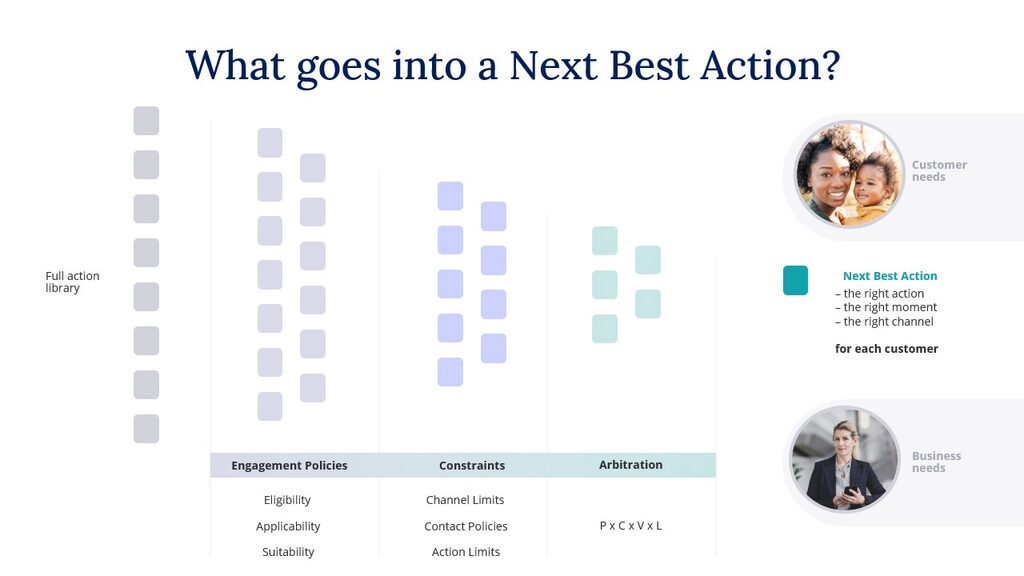
Overcomplicating eligibility slows teams down and limits growth. Organizations that embrace this “human in the loop” approach often scale from 20 to 100+ actions in just a month or two, once marketing and analytics teams align.
A practical roadmap for scaling (with watchouts)
Ready to move beyond a sales-heavy action library? Here’s a three-step roadmap to help you scale effectively – plus some real-world watchouts to keep you on track.
- Use data to find gaps, but don’t overreact to short-term results. Start by analyzing your customer engagement data and journey maps to spot underserved segments or moments. Feed these insights into your Customer Engagement Blueprint to ideate and prioritize actions that address those gaps and deliver more relevant experiences.
- Watchout: Don’t retire actions too quickly if they underperform at first. One Australian bank kept a travel card offer live for eight months with little engagement – until a post-holiday spike revealed a seasonal trend. The lesson: Optionality matters. Unless you no longer offer a product, keep actions available for when the timing is right. Eventually they’ll find the right person at the right time
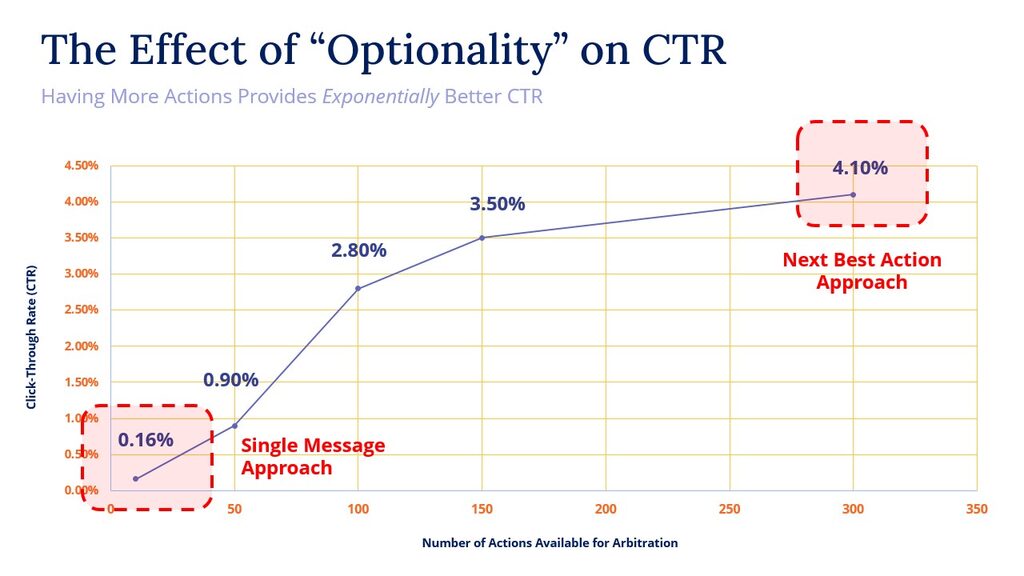
Optionality increases customer engagement and conversion.
- Align marketing and analytics – and keep it simple! Bring your marketing and analytics teams together early. Marketing brings creative ideas; analytics brings data-driven perspective. Together, they can design actions that are both compelling and grounded in reality.
- Watchout: Don’t overcomplicate eligibility rules. The fastest-scaling teams trust adaptive models to do the heavy lifting. Remember, define what customers can get, then let the AI determine what they should get. Overly complex rules slow you down and limit growth.
- Start where your customers are, and vary your treatments. Focus on high-traffic digital real estate first (like mobile apps or online portals) where you can learn and iterate quickly.
- Watchout: Don’t just scale the number of actions; scale the variety of treatments too. If you present the same offer the same way every time, even a robust action library can feel monotonous. Create multiple treatments per channel and leverage AI to help with content creation. This keeps your offers fresh and relevant.
This isn’t a one-and-done task, it’s more like tending a garden – regular care keeps things growing and healthy. Review your action library quarterly: remove outdated offers, identify new opportunities, and build a backlog for development. Make sure your KPIs align with your expanded strategy – success is more than just click-through rates. Track engagement, conversion, and other metrics that matter to your business. If your KPIs don’t match your action library’s focus, it’ll be tough to measure success or secure continued investment.
The competitive advantage you can't ignore
Appointment reminders and profile completion nudges are table stakes – anyone can do those. The real competitive advantage comes from building an action library that’s sophisticated enough to meet customers where they are, with what they actually need. That means moving beyond the traditional campaign mindset and embracing the full power of real-time, adaptive engagement.
The path forward isn't about choosing between customer needs and business goals. It's about understanding that leading with service, retention, and nurture creates the customer receptivity that makes your sales offers more effective. It's about building enough variety that banner blindness doesn't set in. And it's about trusting adaptive models to do what they do best – finding the right action for the right person at the right time.
Organizations that crack this code don't just scale their action libraries. They transform how customers experience their brand.
Ready to get started? Start by mapping your customer journeys and identifying opportunities with Customer Engagement Blueprint. A thoughtful Blueprint will help you design, prioritize, and orchestrate the right mix of actions so you can deliver more relevant experiences, drive engagement, and build lasting customer relationships.