

I’ve always loved organization – not as a nice-to-have, but as the deeply human, slightly chaotic, and ultimately strategic mechanism that helps me survive. And thrive. It’s the very mechanism that helps me bring my best self to both work and life.
Long before I understood my diagnosis of ADHD, I learned that staying organized meant fewer meltdowns, lost threads, missed deadlines. I wasn’t trying to be exceptional – I was trying to function. But over time, this coping mechanism evolved into something powerful: a true differentiator in the workplace.
My SharePoint folders are chronological, alphabetical, or otherwise systematic. My sticky notes and calendars are color-coded. My whiteboards (virtual and real) tell stories of strategy and execution. And that last word? Execution – that’s where it really clicked. Because no matter how brilliant a strategy is, it means nothing if it never sees the light of day.
Strategy can’t win without execution.
Strategy without execution is like a map without a vehicle. And organization is my vehicle. It helps me clear the mental clutter so I can see what matters.
It creates pathways where overwhelm and paralysis once lived. And it’s no surprise that others started to notice.
Accolades and appreciation followed – but not for color-coding. For the outcomes. The meetings that ran smoother. The projects that finished faster. The vision that actually landed. All because I was organized enough to execute it.
When a superpower becomes a stumbling block
But here’s the plot twist.
That very superpower – the one that helped me stand out – can also become a trap. With ADHD and a Type A streak, I can slip into hyperfocus. I’ve spent hours perfecting systems instead of actually doing the work those systems were meant to support. At some point, organizing becomes a form of procrastination. It's like rearranging the bookshelves instead of reading the book.
That exact tension is what sparked my most recent Blueprint creation. I challenged myself to streamline – not obsess over – my process. To create something efficient, understandable, referenceable, and fast.
Blueprint: Where structure meets speed
If you’re not familiar, Pega Blueprint® is our gen AI-powered app that helps anyone – technical or not –turn ideas into executable workflows. You start with a natural language prompt (as personal or tactical as you want), and Blueprint translates it into something structured, shareable, and buildable. It’s strategy, organized.
And what I love most? Blueprint meets you exactly where you are.
From my seat supporting some of the largest healthcare insurance providers in the U.S., I’ve seen Blueprint used to create everything – these are actual Blueprint submissions from our customers:
- “Resolve member and provider inquiries faster”
- “Customer service for product quality and risk”
- “Improve health outcomes”
- “Clinical document processing”
- “Processing and adjudication”
- “Provider data management”
- “Potty training my 2.5 year old”
From fun to foundational, from parenting hacks to life-saving process improvements. That range says everything. Blueprint isn’t just about workflow automation – it’s about possibility. It meets you where you are, whether you're solving for something deeply personal or systemically complex.
Organizing for acceleration
My Blueprint was titled: “Organizing for Acceleration.” It wasn’t about labeling folders or creating color codes. It was about building clarity from the start – and speeding up the path to execution without compromising depth.
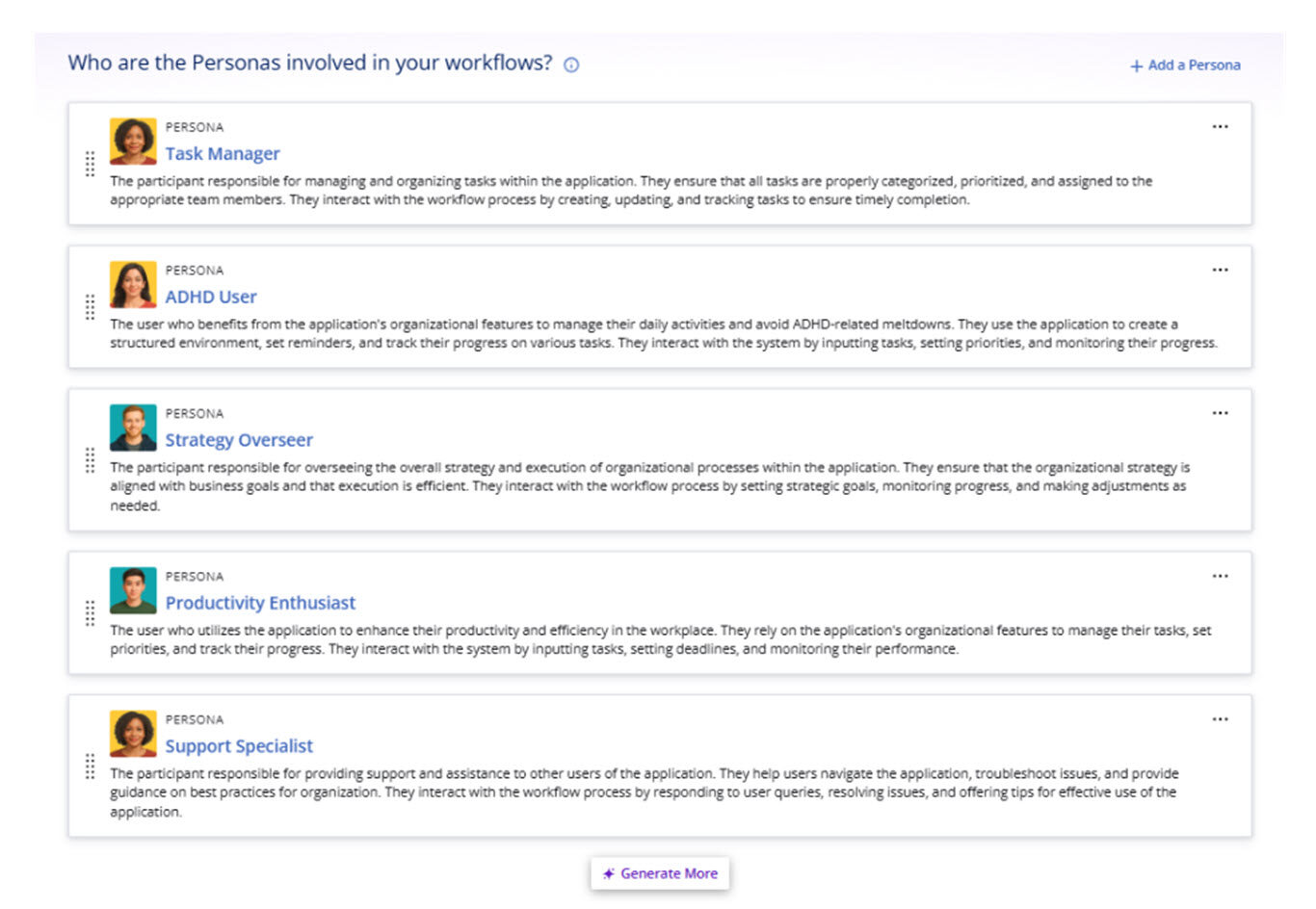
With Blueprint, I didn’t have to choose between thinking and doing. I could do both – fluidly, iteratively, and in a way that actually aligned with how my brain works.
And that’s when I realized:
I’m not just building with our technology. I’m learning from it.
Being a student of our technology
At Pega, we often say: “Be a student of our technology.” And I take that to heart – both professionally and personally.
Each week, I carve out time to experiment with Blueprint. I treat it like a mini lab: a space to think out loud, organize complex thoughts, and translate them into real strategy. No pressure. Just exploration
It’s part of how I learn, iterate, and get better at what I do.
This mindset – that we’re always learning from our technology, not just building with it – resonates deeply with me. In fact, I shared a similar sentiment in the recent blog, “When AI makes us more human: Embracing our best selves at work,” where I described how I used gen AI to work through a moment of analysis paralysis:
“From a personal perspective, I started using gen AI as a supplemental well-being coach in real time... I was stuck in analysis paralysis. And so I went to gen AI and we had a chat back and forth about what I could prioritize – progress over perfection"
That’s what Blueprint helps me do every week: prioritize progress over perfection. Instead, I find new ways to work better – not just faster.
- New ways to simplify complexity.
- New ways to overcome the pull of perfection.
- New ways to move ideas forward.
Execution is the edge
I’m not alone. At PegaWorld iNspire, we heard story after story – from Elevance Health to global banks – about leaders using Pega to execute more effectively. From Elevance Health achieving an 11-point increase in Net Promoter Score by streamlining service with Voice AI to Blue Cross Blue Shield of North Carolina seeing a revenue uplift of more than $500,000 just from implementing digital process automation. But beneath every innovation? The same throughline:
Complexity into clarity – and clarity into outcomes.
We’re in a moment where technology doesn’t just make us faster – it makes us more thoughtful, more focused, and in many ways, more human.
What’s your Blueprint?
So whether you’re neurodivergent like me, detail-obsessed like most strategists, or simply trying to do more with less, I invite you to ask:
What does your organization style make possible? And what does it hold back?
If you’ve ever caught yourself over-perfecting instead of progressing, try this:
- Open Blueprint.
- Type in that messy thought.
- Let gen AI help you shape it into something real.
Because when organization becomes your ally – not your obstacle – you don’t just survive. You accelerate.
Let’s keep learning together.
What’s your Blueprint this week?
Try Blueprint now →