
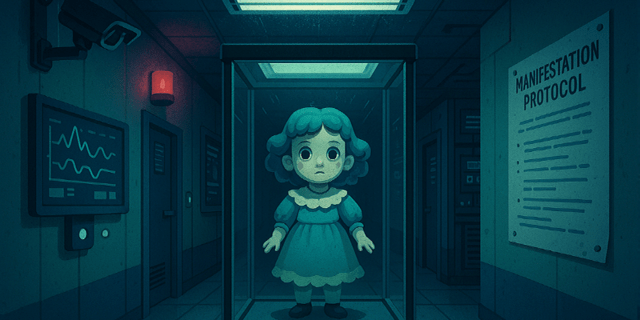
Note: This is a fictional scenario created to see Pega Blueprint® in action. No dolls were possessed, harmed, or actually stored in government facilities during the making of this blog.
It’s just a doll. Cloth body. Painted porcelain face. Faded sailor suit.
The intake report says it was purchased at an estate sale in coastal New England. The movement log says it hasn’t been touched in two years.
The night guard says otherwise. Every few weeks, it’s facing a different direction in its case. The union electrician – a man who’s worked in hurricane-damaged substations and once pulled a live gator out of a utility trench – won’t go near it. “Feels wrong,” he mutters, avoiding eye contact with the glass.
Ridiculous? Sure. But here’s the problem: The doll is officially classified as “non-hazardous.” Which means it’s stored in the same facility as dozens of other high-value, high-risk artifacts, and no one is tracking its movements in real time.
Now, I know what you’re thinking: “Why not just burn it?” Fair question. Unfortunately, the Greater New England Antiquities Preservation Committee (a completely fictional but extremely rule-happy body) insists it’s “culturally significant.” And so the cursed doll stays – moving when the mood strikes it – while a dozen well-meaning humans try to keep track of it using spreadsheets, shared drives, and the occasional Post-It note.
Hands-on with Pega Blueprint®
Pega lives and breathes its own software, and they want all of us to do the same – even marketers like me, whose technical skills are like my husband’s cooking: occasionally impressive, but just as likely to set off the smoke alarm.
That’s why every week, Pega encourages us to get hands-on with Pega Blueprint and push it into new territory. Normally, that means testing a serious use case, like customer onboarding or claims processing.
Me? I set aside time to dream up the most ridiculous possible scenarios just to see how far I can go before I get “spoken to.” Because you can’t just say, “I made an app.” You need a premise. A setting. A reason for it to exist.
Which is why I built an application for the Federal Repository for Anomalous Materials (FRAM), a swamp-adjacent, windowless facility where the vending machines only take exact change and the break room bulletin board includes instructions for both fire drills and “manifestation events.”
Its purpose is simple: to store the kinds of objects no one else wants to admit exist. Artifacts that hum when they shouldn’t. Trinkets that break the laws of physics. Things that, if misplaced, would result in either a catastrophic security breach or at least a 48-hour thread on r/conspiracy complete with grainy photos and arrows in MS Paint.
That brings us to RelicRegistry – FRAM’s fictional but fully fleshed out application, designed to manage the kinds of assets you absolutely, under no circumstances, want getting loose.
Introducing RelicRegistry: Built for containment, not for comfort
Relic Registry is perfect for organizations with zero tolerance for “mystery movements,”, whether they’re tracking Dybbuk boxes or nuclear control rods.
Its workflows include:
- Artifact Intake: Standardizes the capture of metadata like origin story, material, known effects, and risk category (haunted, cursed, blessed, or “pending classification”).
- AI-generated Back Stories: Relic Registry doesn’t just log the doll. It writes its origin story, slaps on a warning label, and recommends a containment protocol based on its materials and mood swings – all using gen AI of course.
- Lifecycle Management: From initial containment through retirement, destruction, or… ritual banishment.
- Incident Response & Containment: Real-time escalation when an object moves, emits light, or breaches containment protocols.
- Occult Object Repatriation: Tracking chain-of-custody across international borders (and dimensions).
And yes, you can swap “haunted doll” with “missile component” or “reactor module” in your mind. The principles are the same.
Same problems, different packaging
Not all cursed objects are dolls. Some are larger, louder, and far less portable.
Consider the “Lantern That Burns Without Fuel” – a fictional artifact that throws off heat, corrodes anything metal within five feet, and occasionally shows a smiling face in its flame. Handling something like that isn’t all that different from managing a reactor module or a critical substation transformer. Objects like this rely on:
- Time-sensitive maintenance: The lantern’s flame has to be ritually quenched and rekindled, or its “output” becomes unpredictable. Nuclear facilities have the same relationship with inspection intervals – skip one, and you’re suddenly in failure mode.
- Containment protocols: Whether you’re maintaining a salt circle or a safety lockout, the goal is the same – to stop dangerous assets from becoming dangerous situations.
- Interdependent systems: The lantern sits in proximity to other sensitive artifacts, and a flare in one can cause a cascade of issues in the others. It’s no different from the way substations, grid components, and safety systems react to one another under stress.
- High-risk storage: Whether it’s a lead-lined containment room or a reinforced reactor vault, you need both environmental control and constant monitoring to prevent something from crossing the threshold from “contained” to “catastrophic.”
- Standardized decommissioning protocols: When an artifact becomes too unstable to contain – say, it starts whispering in Latin and singeing the eyebrows off hapless researchers – RelicRegistry triggers a full decommissioning workflow.
RelicRegistry is designed to flag problems before they turn into emergencies. Whether that means spotting a heat spike in an eldritch lantern or a pressure anomaly in a reactor casing, the logic is the same: find it early, contain it fast, and document every step so you can prove to your Board of Directors that you did it right.
Why haunted dolls make for great QA
Here’s the thing about designing an app to manage haunted dolls and cursed tea sets that refill themselves: none of those scenarios are real. But the operational problems they expose? Those are very real, and often invisible until you push a system into absurd extremes.
Working through these impossible use cases with Pega Blueprint forces you to test:
- How the system behaves under unpredictable conditions, because if it can handle a lantern that gets angrier when cooled, it can handle an industrial chiller with erratic readings.
- Where workflows break down between teams; if containment involves three teams and a moon-phase chart, you’ve just modeled complex, time-sensitive collaboration in the field.
- How alerts and escalations are prioritized; when you’ve got five simultaneous cursed object incidents, you learn very quickly whether your system knows which one to deal with first (spoiler: it’s always the one emitting smoke and singing).
The magic of the absurd is that it strips away the polite constraints of “normal” business cases. No one feels territorial about fictional assets. No one’s work is called into question. You can explore extreme edge cases without politics or paperwork slowing you down. And in doing so, you find out just how far – and how fast – you can go.
If your system can survive a cursed object outbreak, it can survive a compliance audit.
What paranormal asset management teaches us about real risk
Whether you’re standing in the climate-controlled hush of FRAM’s headquarters or in the turbine hall of a nuclear plant, the mission is the same: track it, contain it, escalate when needed, and never let it wander off without a timestamp.
High-stakes asset management isn’t just about storing things. It’s about anticipating the worst-case scenario and making sure it never has a chance to happen. In our hypothetical vault, that might mean ensuring the sailor-suited doll never leaves its glass case. In energy, it might mean catching a microfracture in a reactor module before it becomes a headline.
The tools, as it turns out, are remarkably transferable:
- Rich metadata for provenance and condition history.
- Automated, rules-based containment checks.
- Cross-team, real-time escalation channels.
- Pattern recognition that spots small anomalies before they turn into systemic failures.
RelicRegistry may never actually be deployed in the wild, but its Blueprint proves a point: If you can build a system that can manage cursed artifacts, you can build one that can manage anything.
So here’s your invitation: Imagine your own “impossible” scenario. Swap in the weirdest, most impractical asset you can think of, and then see how far Pega Blueprint can take you toward a credible, testable solution.
The best way to make the improbable possible? Start by designing for the impossible.