

Most enterprises have an org chart, a process manual, and documented workflows describing how things are supposed to happen. Yet very few of them can show how work actually happens at the level of individual clicks and handoffs.
That gap hides compliance risk. It buries the best automation opportunities. It quietly drains employee time on friction nobody can see, and it lets the same process run five different ways across five teams.
This is why process intelligence is now its own category: Organizations can't improve what they can't see, and AI without operational context is guesswork. Gartner calls this out directly, noting that companies scaling AI need that context to decide where to apply it. Pega was named a Leader in the 2026 Gartner Magic Quadrant for Process Intelligence Platforms out of 13 vendors evaluated, after earning the same recognition in 2025.
Two lenses, one picture
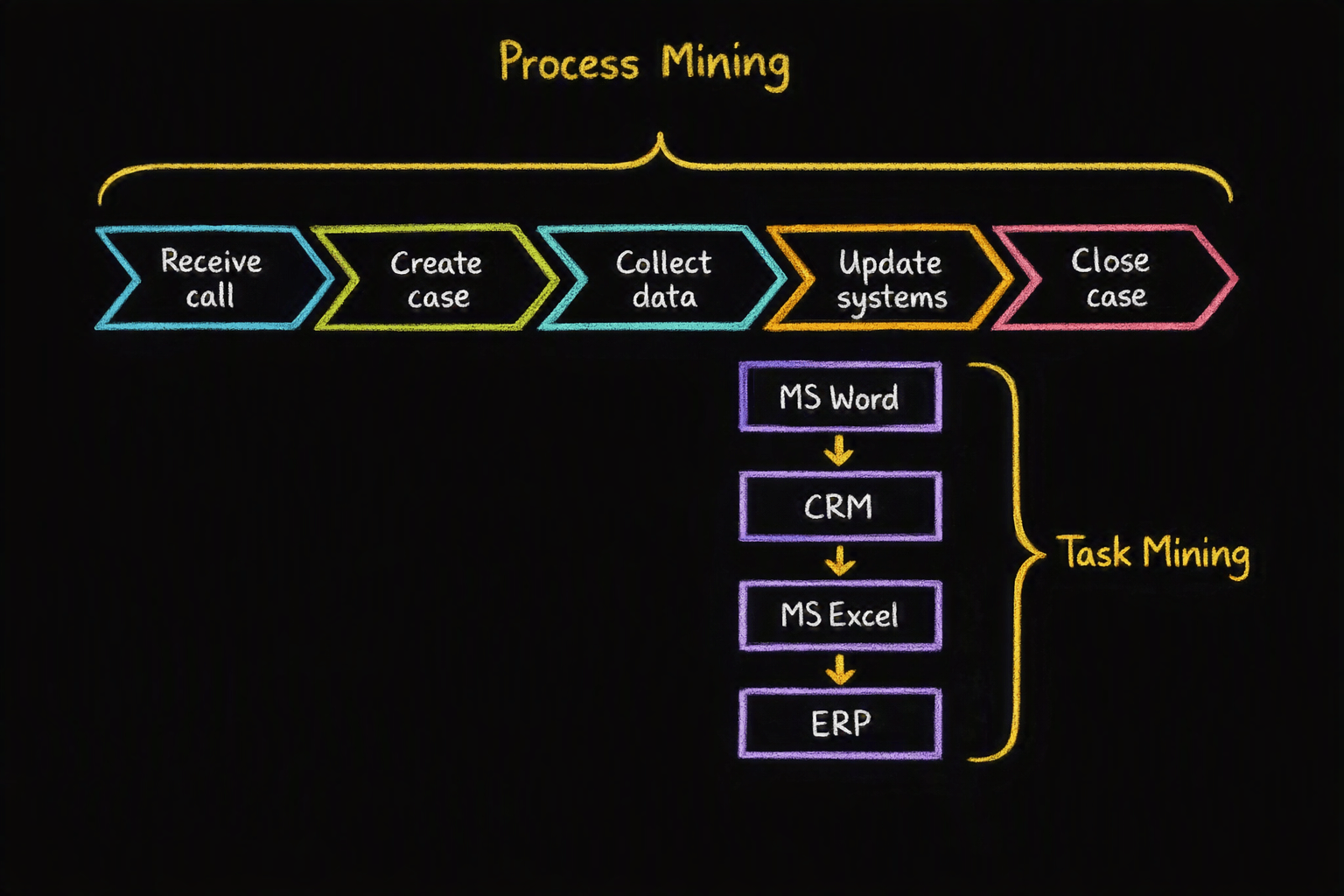
Process mining and task mining are different tools, and the distinction matters. Process mining ingests event logs from the systems where work already runs (ERP, CRM, case management, service platforms) and reconstructs the end-to-end flow: where it speeds up, where it stalls, where it deviates from the documented path. Task mining works at the desktop layer, capturing the clicks, the app-switching, and the manual steps nobody wrote down because they became habit years ago.
Neither view is complete on its own. Process mining without task mining tells you a step is slow but not why. Task mining without process mining shows friction without showing where it sits in the larger flow. Together they replace assumption with evidence: how work actually gets done, rather than how it's supposed to.
The order matters. Each step below depends on what the previous one makes visible.
See it: Catch compliance risk before it becomes an incident
The traditional approach to compliance is retrospective. Spot checks, sample audits, post-incident investigations. Process mining surfaces deviations in the live process, not the documented version. It’s a step that requires a second approval but routinely skips it. A workaround that became the unofficial standard. An audit trail that used to take weeks to reconstruct manually, available on demand.
The point is timing. A pattern of deviation caught early is a correction. The same pattern caught by a regulator is an incident.
Prioritize it: Find the automation candidates worth funding
Once real process data is visible, the next question is where automation investment should go first. Many automation roadmaps rest on intuition: This process feels slow. Mining data replaces the guessing with a ranked view of which processes carry the highest volume, the most repetition, and the clearest return for RPA or intelligent automation. In one case, mining revealed that the equivalent of 25 full-time employees’ time was being spent just fetching information from different systems, a cost that was invisible because it was spread across hundreds of people doing it a few minutes at a time.
Consider a common situation: Leadership assumes the claims team is the top automation candidate because it generates the most complaints. Mining data shows that a procurement function nobody flagged actually carries far more manual rework hours per transaction, but the team never escalated because they built workarounds instead. Without the data, the wrong process gets automated first and the highest return work stays invisible.
Feel it: Give employees their time back
At the desktop level a different picture emerges, one about people rather than systems. Task mining reveals the friction that slows employees down every day: re-keying the same data into two systems, switching between a dozen tabs to complete one request, workarounds that persist because no one had the visibility to fix them. One task mining deployment found that employees were spending 250 seconds of copy-paste work on every single onboarding, a step so embedded in the routine that nobody thought to question it.
This friction rarely shows up in surveys, but it shows up in attrition and in the sense that work has gotten harder than it should be. Removing it improves how people experience their jobs, and that matters as much as the recovered hours.
Scale it: Standardize what works
The last step is making sure a fix does not stay local. At a multinational healthcare company, a manager used task mining and noticed that Notepad was slowing down one user on one team. That looked like a single-person problem. When they dug into the data, they found that all new starters across the function were exhibiting the same behavior, because the training team had been giving them the wrong instructions. The individual symptom was minor. The systemic cause affected every new hire.
That is what scaling process intelligence looks like: One finding on one desktop turns into a correction to the training program, which fixes the problem for everyone who follows. Standardization turns a local improvement into workflow optimization across the organization. It also creates a monitoring baseline. Once processes are aligned, the same mining tools that found the original variation can detect future drift as it starts, rather than letting it accumulate silently until someone runs another audit. That's the difference between fixing one team and knowing when the process slips again across all of them.
Think bigger than a pilot
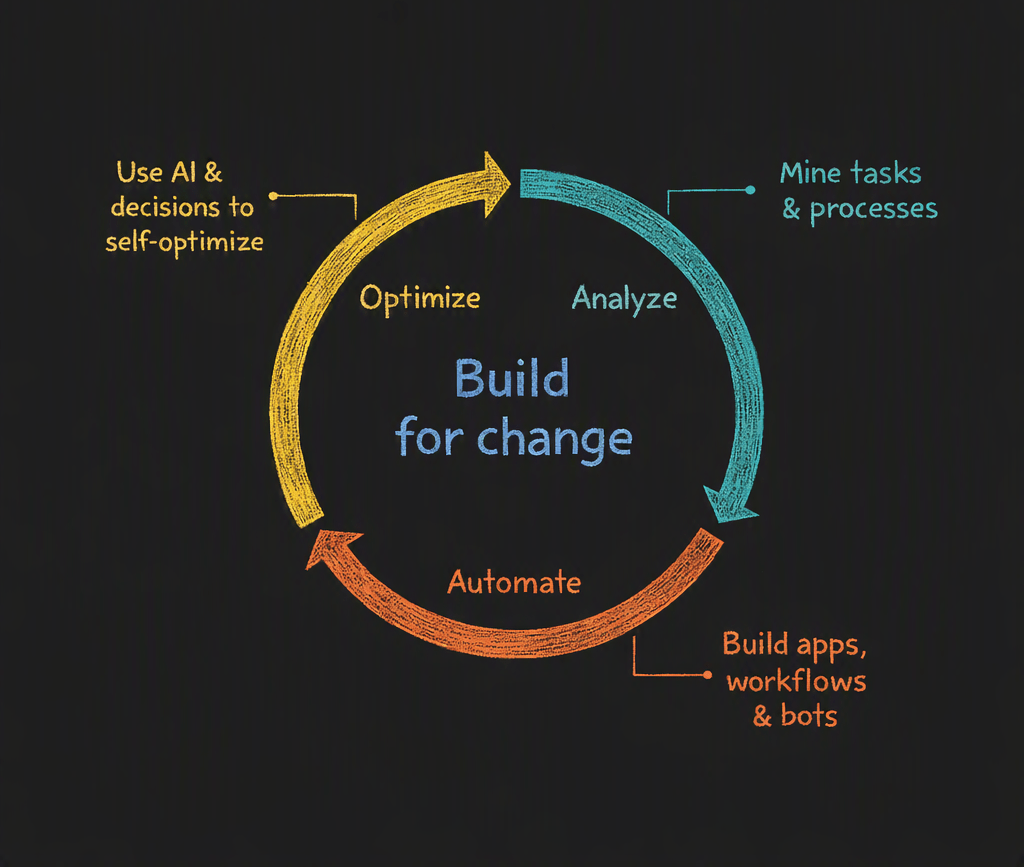
Visibility only pays off when it leads to a change. Pega's Gartner recognition is relevant here because the process intelligence category evaluates exactly that: Platforms that connect discovery to automation and workflow improvement, judged at a market level across 13 vendors rather than claimed in a product brochure. Pega makes this connection concrete: Process mining integrates directly with Pega GenAI Blueprint™, sending business process model and notation (BPMN) maps straight into Blueprint to generate application designs with stages and steps that reflect how the process actually runs. The path from "we found a problem" to "here's a build-ready workflow" does not require moving data between tools or starting the design from scratch.

The conventional advice is to start small: Pilot one process on one team and expand from there. That works for proving the tooling. It does not show how the business actually runs. A single team's data shows you that team's habits. The findings that change how an organization operates, like the same process running five different ways across regions, or a deviation pattern that only appears at volume, require deploying broadly enough to compare. Scale is not a later step. It's where those patterns become visible.
Ready to see how work really gets done in your organization? Explore Pega Process Mining and Pega Task Mining, or connect with the Pega team to plan a deployment built for comparison, not just a pilot.