Agentic orchestration
Drive smarter, adaptive systems with AI agents that work together
What is agentic orchestration?
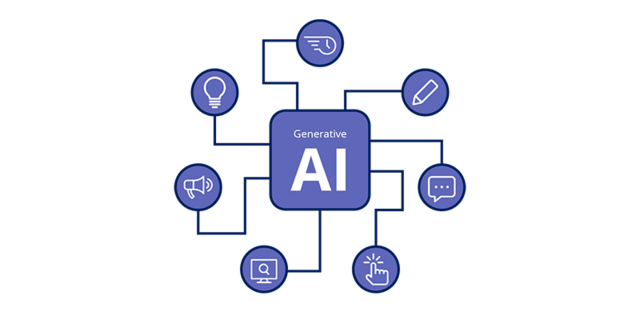
Agentic orchestration is the next evolution of AI – where specialized agents collaborate to achieve complex goals. Each agent brings unique skills, working together seamlessly to deliver optimal business outcomes. This intelligent coordination enables organizations to automate complex processes, provide real-time guidance, and adapt workflows dynamically to meet changing business needs.
Why is agentic orchestration important?
Agentic orchestration unlocks a new level of intelligent automation by enabling AI agents to collaborate, adapt, and make decisions in real time, driving efficiency, scalability, and innovation across industries.
Benefits of agentic orchestration
- Scalable intelligence: Easily add new specialized agents to handle growing complexity without rebuilding entire systems.
- Dynamic adaptability: Agents can adjust their strategies in real time based on changing business conditions and new data.
- Enhanced decision-making: Multiple AI agents contribute specialized insights, leading to more adaptive and intelligent business decisions.

How does agentic orchestration work?
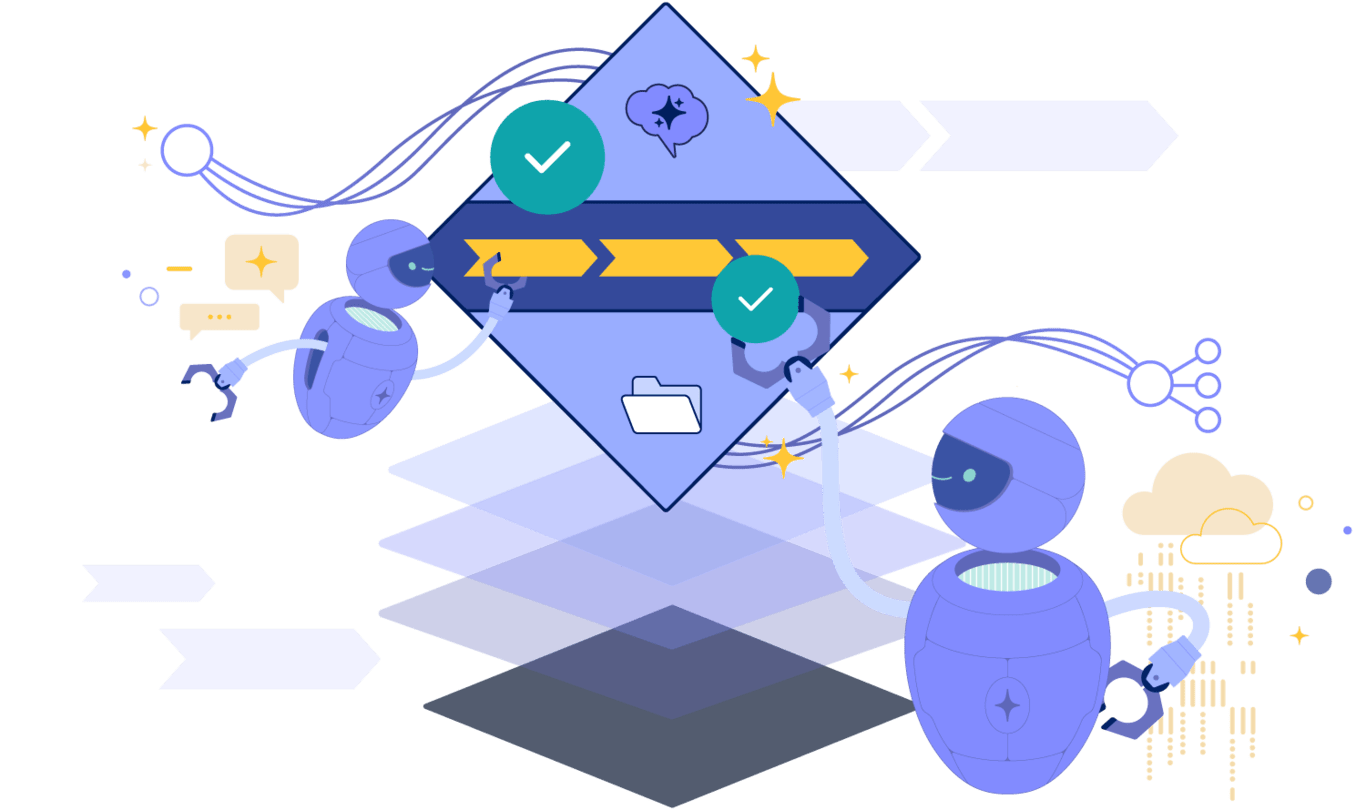
Agentic orchestration works by coordinating multiple AI agents—each with specialized skills—so they can collaborate to achieve a larger goal. Instead of relying on a single model to handle everything, the system assigns tasks to the most capable agent, manages their interactions, and integrates their outputs. This creates a more flexible, adaptive approach that allows AI to handle complex, dynamic workflows efficiently.
See how Pega brings agentic orchestration to life
Common use cases for agentic orchestration
Customer service excellence
Enable conversational self-service agents, sentiment analysis agents, and decision engines to provide personalized customer experiences.
Supply chain intelligence
Coordinate demand forecasting, inventory optimization, and logistics planning agents for end-to-end supply chain efficiency.
Risk management
Integrate fraud detection, compliance monitoring, and decision-making agents for comprehensive risk assessment and mitigation.

Key barriers to enterprise-scale agentic orchestration
Moving from isolated AI experiments to coordinated enterprise execution creates a new set of operational challenges. Success depends less on deploying more agents — and more on building the right environment for them to work together.
- Disconnected data: Agents are only as effective as the data they can reach. When information lives across siloed systems, channels, and teams, agents lose continuity — and decisions suffer.
- Scaling from tasks to outcomes: Most organizations can automate individual tasks. Far fewer can coordinate work across complete business processes. True orchestration means connecting decisions, actions, and handoffs into a system that drives measurable results.
- Adapting in real time: Business priorities shift. Customer expectations rise. Orchestration needs to flex dynamically — without forcing teams to redesign workflows every time conditions change.
As agentic systems mature, the real opportunity isn't more intelligence. It's creating the structure that lets intelligence operate consistently across the business.
The future of agentic orchestration
Building an agentic operation means putting AI you can trust at the center of the customer journey. To move into the future, organizations need to scale AI quickly and with confidence. Agentic orchestration makes this possible by:
- Accelerating modernization: Retiring legacy apps, automating workflows, and speeding the move to the cloud.
- Enforcing governance: Ensuring rules, regulations, and standards are consistently followed across operations.
- Connecting the enterprise: Bridging front-, mid-, and back-office so experiences and operations flow seamlessly.
- Driving end-to-end orchestration: Coordinating people, AI, and systems to deliver work faster and more intelligently.
- Guiding employees: Helping them focus on what matters most, working more effectively with AI assistance, and onboarding rapidly.
This is the foundation for the next era of agentic orchestration – where trusted AI doesn’t just automate tasks but orchestrates the enterprise to adapt and perform at speed.